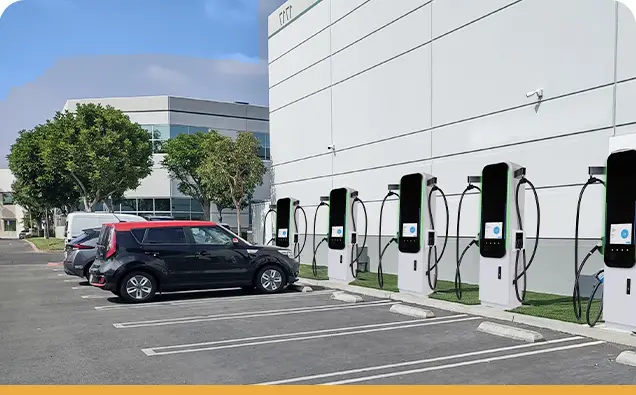
Commercial EV Charging Station Installation
Commercial EV charging station installation for offices, fleets, apartments, and parking facilities. Licensed electric vehicle charger installers. Incentives guidance.
- Licensed electricians
- Free quote
- No obligation
Quote request sent.
A licensed electrician in your area will be in touch within 1 business day.
The federal Section 30C commercial EV charging tax credit expired on June 30, 2026 and is no longer available for new installations. Utility make-ready rebates and state programs remain available year-round — ask your matched electrician what applies in your area.
Commercial Electric Vehicle Charging for Your Business
Commercial EV charging is no longer optional — it's a competitive advantage. Employees, tenants, and customers expect electric vehicle charging stations on-site. Utility make-ready programs and state grants can still cover a significant share of the project cost.
We match you with licensed commercial electricians experienced in commercial EV charging station installation, multi-unit deployments, load management, and networked charger platforms.
Utility Rebates & State Grants — Federal 30C Credit Ended June 30, 2026
The commercial Section 30C credit covered up to $100,000 per charger port, but it expired on June 30, 2026 under the One Big Beautiful Bill Act and is not available for new installations. Equipment placed in service on or before that date may still be claimed on IRS Form 8911. Utility make-ready programs and state grants remain active in most markets and can still offset a significant share of commercial infrastructure cost. Consult your tax advisor.
Request a Commercial Quote →Commercial EV Charging Station Installation
Commercial EV charging station installation is a different discipline from residential work. It requires utility coordination for load studies, demand charge management software, ADA-compliant station placement, and compliance with NEC Article 625 for electric vehicle power transfer. Our network includes electricians who specialise specifically in commercial EV charging station installation — from a single Level 2 wall unit to a multi-bay DC fast charging deployment.
Whether your property needs a public-facing networked charging station (ChargePoint, Blink, or EvoCharge), a Tesla Wall Connector deployment for a Tesla fleet, or a private depot with managed load balancing, we'll match you with an installer who has done this exact type of project before.
Tesla Wall Connector for Business — Apartments, Hotels & Workplaces
Tesla's Wall Connector for Business program has expanded aggressively in 2026 — adding hundreds of new connectors at multifamily and workplace sites in biweekly deployments targeting apartments, hotels, and offices. Properties that complete the commissioning process with a licensed installer are eligible to appear on Tesla's in-vehicle charging map, making the property discoverable to every Tesla driver in the area.
The driver: Tesla requires sites to be commissioned by a qualified installer to appear on the map. A property that self-installs Wall Connectors without proper commissioning does not appear on Tesla's network — missing the visibility benefit that drives the program's value for property managers.
We are actively matching property managers in the following high-growth markets with licensed installers qualified to commission Tesla Wall Connector for Business deployments:
- Los Angeles, CA — highest EV density in the country; apartment and condo buildings face increasing tenant demand for onsite charging
- Denver, CO — rapidly growing EV market; Colorado state incentives and Xcel Energy rebates reduce net deployment costs significantly
- NY/NJ Metro — Right to Charge laws in both states accelerate multifamily EV charging adoption; strong demand from property managers of pre-war buildings seeking modern amenities
Typical Tesla Wall Connector for Business deployment for a 20-unit apartment building runs $8,000–$25,000 installed, depending on panel capacity, parking configuration, and load management requirements. Utility make-ready programs in LA (SCE), Denver (Xcel), and NYC (Con Ed) can offset a substantial portion of infrastructure costs. Check with your tax advisor about federal and state incentives currently available in your area.
Property Managers: Get a B2B Quote
We connect apartment buildings, hotels, offices, and parking facilities with licensed commercial electricians in Los Angeles, Denver, and the NY/NJ metro. Tell us your property type, number of parking spaces, and target market — we'll match you with an installer who has completed Tesla Wall Connector for Business deployments in your area.
Request a Commercial Quote →We Serve
Commercial EV Charger Installation Cost for Businesses
Commercial EV charger installation cost varies widely based on the number of stations, electrical infrastructure work required, and whether trenching or panel upgrades are needed. Typical ranges:
| Deployment Type | Typical Cost Range | Best For |
|---|---|---|
| Single Level 2 station | $1,500–$5,000 | Small office, retail, 1–3 spaces |
| 4–10 Level 2 stations | $15,000–$60,000 | Office parking lot, hotel, retail center |
| DC Fast Charger (DCFC) | $50,000–$150,000+ | High-throughput public charging, fleet depot |
| Panel / service upgrade (if needed) | $5,000–$30,000+ | Older buildings, large load additions |
Federal and state incentives can offset 30–50% of these costs for qualifying businesses. Submit a free quote for an estimate specific to your property.
ROI: When Does Commercial EV Charging Pay for Itself?
Payback period for commercial EV charging infrastructure depends on the revenue model you choose:
- Employee benefit / free charging: No direct revenue, but studies show EV-charging amenities improve talent retention and can justify a rent premium of $50–$150/month per tenant in multifamily settings. Payback is measured in lease retention, not charging fees.
- Fee-based customer charging: At $0.35–$0.55/kWh (typical networked charger rates), a single Level 2 station serving 3–4 sessions/day generates $1,200–$2,400/year in gross revenue. A 4-station parking lot at $40,000 installed breaks even in 4–8 years — before incentives.
- Fleet depot charging: ROI is calculated against fuel savings. At $0.12/kWh off-peak (with TOU rate management) vs. $4.50/gallon diesel equivalent, electrified fleet vehicles save $800–$1,500/vehicle/year. A 10-vehicle depot recoups a $30,000 charging installation in 2–4 years.
Federal and State Incentives: Stacking Your Savings
Commercial EV charger installation remains one of the more heavily subsidised capital expenditures available to US businesses, even after the federal Section 30C credit closed on June 30, 2026. Programs still stack — you can often combine a state grant and a utility rebate on the same installation.
Section 30C Federal Tax Credit — How the Commercial Credit Works
The Alternative Fuel Vehicle Refueling Property Credit (Section 30C) expired for property placed in service after June 30, 2026 — the One Big Beautiful Bill Act (P.L. 119-21) moved the termination date forward from December 31, 2032. Businesses that completed and energised a qualifying installation on or before June 30, 2026 can still claim the credit on IRS Form 8911; check with your tax advisor. Utility make-ready programs and state grants are unaffected by the federal change and remain available (see below).
| Credit Rate | Condition | Max per Port |
|---|---|---|
| 6% base rate | All qualifying commercial installations in eligible census tracts | $100,000 |
| 30% enhanced rate | Prevailing wage paid + apprenticeship requirements met | $100,000 |
Key requirements, for installations placed in service on or before June 30, 2026: the site must be in a qualifying low-income or non-urban census tract; the equipment must have been placed in service (operational) by June 30, 2026; prevailing wage compliance is required to access the full 30% rate. The credit is not available for property placed in service after that date. Consult your tax advisor — these rules are complex and project-specific.
Utility Make-Ready Programs
Many utilities fund the "make-ready" infrastructure — the electrical panel work, trenching, and conduit up to the parking space — at no cost to the property owner. You pay only for the charger hardware. Programs vary by utility:
- PG&E (California): EV Fleet Program and Business EV Charging Program cover make-ready costs for qualifying sites
- Con Edison (New York): Make-Ready program covers utility-side infrastructure at no cost for commercial customers
- Xcel Energy (CO, MN, TX): Commercial EV rebates of $500–$2,500 per Level 2 port installed
- FPL (Florida): EV Fleet Charging Program with rebates for commercial installations
State Grants and Low-Interest Financing
California, New York, Colorado, Washington, and Massachusetts all operate state-level grant programs for commercial EV charging. Most prioritize publicly accessible locations and disadvantaged community sites. Your matched installer can help identify applicable programs before you finalize the project scope.
Incentive Stacking Example
| Item | Amount |
|---|---|
| 4-station Level 2 parking lot installation | $40,000 |
| Utility make-ready program (varies) | −$5,000–$15,000 |
| State grant (qualifying sites) | −$2,000–$10,000 |
| Net effective cost (after incentives) | $15,000–$33,000 |
Note: This example reflects incentives available today. The Section 30C federal credit, which would have deducted a further 30% (−$12,000 on this project), expired on June 30, 2026 and is excluded — only installations placed in service on or before that date could claim it. Consult your tax advisor for the credits and grants currently available in your area.
Incentives: What's Available Now
The federal Section 30C commercial credit expired on June 30, 2026 and is closed to new installations. Utility make-ready programs and state grants remain available in many markets — ask your matched electrician about current programs in your state and utility territory.
How to Get an Accurate Commercial EV Charging Quote
A commercial installer can scope your project faster — and quote more accurately — when you have a few details ready. Before you request a quote, it helps to know:
- Number of charging ports you want now, and any plans to expand later (over-sizing the electrical run up front is far cheaper than re-trenching).
- Charger type — Level 2 for workplaces and overnight depots, DC fast charging for public or high-throughput sites.
- Parking layout — distance from the electrical room to the spaces, and whether the route is surface lot (trenching) or structured garage (conduit).
- Electrical service — your main panel or switchgear amperage, if known, which determines whether a service upgrade is needed.
- Networking and access — whether you need payment, access control, or load-management software.
Don't have all of this yet? That's fine — your matched electrician confirms it during the site assessment. The full scope is the same whether you call it commercial EV charger installation or commercial electric vehicle charging station installation: site assessment, utility coordination, permit filing, equipment mounting, load-management configuration, and final inspection.
Frequently Asked Questions
What types of commercial properties do you serve?
What commercial charger brands do you support?
Are there incentives for commercial EV charging installations?
How long does a commercial installation take?
Do you handle load management and network connectivity?
How much does commercial EV charger installation cost?
What is the difference between commercial EV charger installation and commercial electric vehicle charging station installation?
Do you handle commercial EV charging installation for fleets?
What is the Tesla Wall Connector for Business program?
Get a Commercial EV Charging Quote
Licensed electricians · Fast response · No obligation
Request My Free Quote →Utility & state rebates — check what applies in your area.